 |
Harvest on the Plains
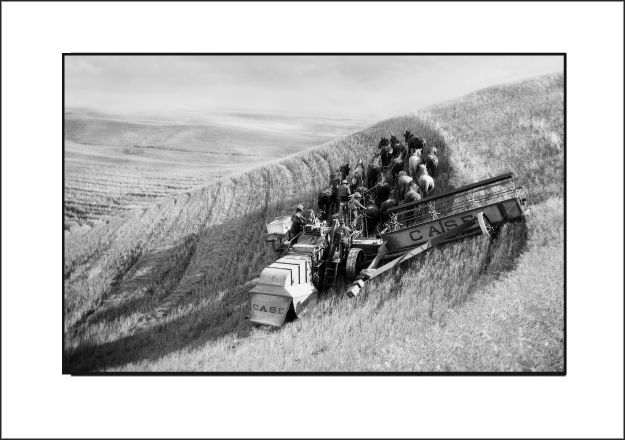
Often referred to as the country's "breadbasket," America's Midwest and Great Plains are rich in farm heritage. And the greatest leaps in farming innovations coincide with the settlement and subsequent development of these agricultural meccas. Through the 1830s and 1840s, when homesteaders were moving West towards the Mississippi and beyond, a variety of new farm equipment was being introduced - threshers, reapers, plows and combines (combination reaper and thresher). Replacing manpower with horsepower, these early horse or ox-driven implements began a revolution in farming practices. With the average farmer now increasing his production capacity and the agricultural market expanding, the development of more efficient machinery was well underway. Steam engine technology was soon adapted to farming needs. Yet, even though steam engines powered the actual machinery, a team of up to twenty horses was still needed to pull that powered equipment through the fields. The use of horses would continue into the 20th century until tractors became another chapter in the mechanization of farm machinery. Photographed in 1929, the steam-powered "hillside combine" seen here is specifically designed to operate on steeper slopes.
Price: $3.95
|


