 |
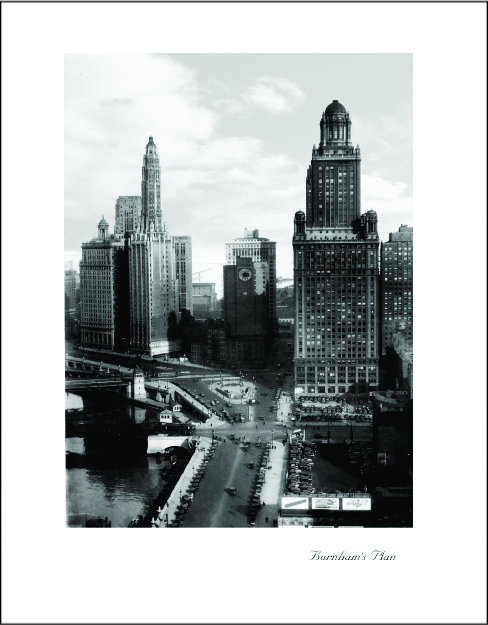
Burnham's Plan
Daniel Burnham presented his most ambitious work, the Plan of Chicago, in 1909. Co-produced with architect Edward H. Bennett, the plan anticipated by several decades the need to provide for Chicago's growing population. Their proposed system of city parks, civic buildings, commercial boulevards, transportation routes and lakefront recreation areas not only influenced Chicago's development, it set the standard for urban design. Foreseeing the need to accomodate urban growth, Burnham envisioned a two-tiered avenue that would restrict commercial vehicles to the lower level and allow only automobiles to use the upper level. With Henry Ford's assembly-line mass production of Model T's making automobiles more affordable for the middle and working classes, the city streets became congested and Burnham's idea came to fruition. The Chicago Plan Commission followed through with the double-decker boulevard concept and approved the construction of Wacker Drive. Built in 1926 and named after Charles Wacker, a chairman on the Chicago Plan Commission, Wacker Drive remains a testament to Burnham's philosophy: "Make no little plans; they have no magic to stir men's blood and probably themselves will not be realized. Make big plans; aim high in hope and work, remembering that a noble, logical diagram once recorded will not die."
Price: $2.95
|


